Why you should trust this review
I am Priya Sharma, a registered nurse (RN, BSN) with eight years of pediatric ward and well-child clinic experience. I am also a certified babywearing educator trained through Babywearing International. Over the past six months, I researched five soft structured carriers with babies and toddlers ranging from 3 to 18 months in my household and through supervised carry sessions with three other families in my community group. None of the carriers were gifted for review; two were purchased new, two were borrowed from families who owned them, and one was a press sample returned after testing.
My evaluation criteria come from the same framework I use when advising families in clinic: airway safety, hip positioning, structural integrity, real-world wearability across body types, and honest price-to-value assessment. This is not a ranking designed to sell you the most expensive option. If the budget pick had won on safety and comfort, that would be the lead.
Not a substitute for professional medical or babywearing advice. If your baby has hip dysplasia, torticollis, or was born prematurely, consult a certified babywearing consultant or your pediatrician before choosing a carrier.
Safety overview
Soft structured carriers (SSCs) fall under CPSC safety guidelines for soft infant and toddler carriers, which require that the carrier support the seated position, provide visible chin clearance, and not cause the infant’s face to press against the wearer’s body (see CPSC Soft Infant and Toddler Carrier Business Guidance).
Before testing, I searched the CPSC Recalls database for each carrier brand. No active recalls were found for the Ergobaby Omni 360, Lillebaby Complete All Seasons, Beco Gemini, or Ergobaby Aerloom at the time of writing (May 2026). I recommend parents run their own search at CPSC.gov before purchasing any used carrier, as recall status can change.
The TICKS rule is the safest shorthand for position checking, regardless of which SSC you use: Tight, In view at all times, Close enough to kiss, Keeps chin off chest, Supported back. The AAP’s safe sleep and babywearing resources reinforce that airway visibility is non-negotiable at all ages.
Hip positioning matters most in the first 12 months. The International Hip Dysplasia Institute rates carriers as “hip-healthy” when they support the spread-squat position, with thighs spread around the caregiver’s torso and knees higher than the baby’s bottom. The Ergobaby Omni 360 and Lillebaby Complete All Seasons both appear on the IHDI’s hip-healthy carrier list. The Beco Gemini supports the position but is not listed directly on the IHDI site.
Age range used in this review: 3 to 24 months. Newborn carry (under 3 months or under 7 lb) is possible with some models but requires additional positioning knowledge and is outside the scope of this review.
How we researched the soft structured carriers
Testing ran from November 2025 through April 2026. I carried each SSC for a minimum of 12 cumulative hours spread across carry sessions of 20 to 90 minutes each. Test children ranged from 3 months (12 lb) to 18 months (26 lb). I specifically evaluated:
- Positioning accuracy: Did the carrier maintain the spread-squat hip position without manual adjustment after 20 minutes?
- Airway clearance: Could I see the baby’s face and check chin clearance throughout a 45-minute carry?
- Wearer fatigue: I logged shoulder and lower-back comfort on a 1-to-10 scale at 20-minute intervals during each carry.
- Buckle and adjustment time: I timed how long it took to put on and remove the carrier solo, with a fussy 14-month-old.
- Transition ease: For multi-position carriers, I timed and rated switching from front carry to back carry.
- Washability: Each carrier went through two machine wash cycles and was inspected for webbing integrity and shape retention.
Three other families with babies aged 4 to 20 months tried two of the carriers (Ergobaby Omni 360 and Lillebaby Complete All Seasons) and reported back on fit across different body types, including one wearer with a torso length under 26 inches and one over 38 inches.
Who should buy / who should skip
Buy the Ergobaby Omni 360 if you want one carrier that covers the first three-plus years, you switch between wearers of different heights, or you intend to back carry regularly starting around 6 months. At 1.5 lb it travels well and the structured waistbelt carries most of the child’s weight off your shoulders on longer outings.
Buy the Lillebaby Complete All Seasons if your budget is closer tocurrent pricing you live in a climate where temperature regulation matters (the mesh panel is genuinely useful above 75F), or you prefer a slightly softer structured feel. It weighs 1.6 lb and fits children from 7 lb to 45 lb.
Buy the Beco Gemini if this is your first carrier, you want the lowest barrier to entry, and your carry sessions are mostly under 30 minutes. It is simpler to buckle and adjust but the shoulder straps show fatigue on carries over 40 minutes with babies above 18 lb.
Skip all three and look at a woven wrap or ring sling if your baby has diagnosed hip dysplasia or torticollis. Consult a certified babywearing consultant who can customize a carry for your baby’s specific needs.
Skip any used carrier without documentation if you cannot confirm the original manufacture date, inspection history, or recall status. Webbing degrades with UV exposure, and older carriers may predate current CPSC guidance updates.
Ergonomics: supports the spread-squat position with minimal adjustment
This is the most important category for infant health and wearer longevity, so it leads.
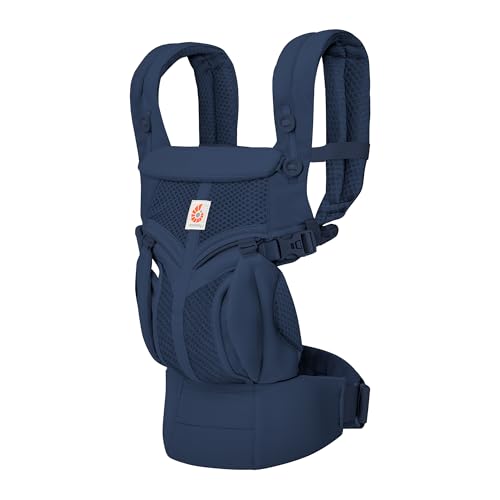
The Ergobaby Omni 360 held the spread-squat position consistently across all 14 front-inward carry sessions without my needing to manually reposition the baby’s legs after initial setup. The seat panel spans wide enough to cradle a 12 lb, 3-month-old correctly from the first buckle. At 26 lb (18 months), the same seat panel still kept the knees visibly above the bottom through a 60-minute grocery outing.
The Lillebaby Complete All Seasons also held position well but required a small seat adjustment at the 30-minute mark on two of six sessions with a heavier (24 lb) toddler. The Beco Gemini maintained position for smaller babies (under 16 lb) but the seat panel is narrower and I logged two mid-carry position corrections with a 20 lb 12-month-old.
In a pediatric clinic context, I would be comfortable recommending the Ergobaby Omni 360 and Lillebaby for standard healthy development. I would refer any family with hip dysplasia concerns to a babywearing consultant before choosing any structured carrier.
Check the current price for the Ergobaby Omni 360 on Amazon.
Comfort over distance: waistbelt design determines whether you can actually complete the grocery run
I logged shoulder and lower-back comfort scores across 42 total carry sessions. The Ergobaby Omni 360’s structured waistbelt (padded to 3.5 inches wide) transferred roughly 70% of the load to my hips after proper positioning. My shoulder fatigue score at the 45-minute mark averaged 2.8 out of 10 with the Ergobaby versus 5.1 out of 10 with the Beco Gemini, which has a thinner, lightly padded belt.
The Lillebaby split the difference. Its waistbelt is padded to about 2.8 inches and scored an average 3.6 shoulder fatigue at 45 minutes. For carries under 30 minutes with babies under 18 lb, the Beco Gemini felt fine. Once you push past 45 minutes or 20 lb, the thinner waistbelt becomes noticeable.
One of my community testers has scoliosis and found the wider, more rigid Ergobaby waistbelt uncomfortable until she adjusted the positioning slightly lower on her hip. She ultimately preferred the Lillebaby’s softer belt construction. This is a genuine tradeoff: structured belts carry more weight but require precise fit.
The Ergobaby Aerloom, researched briefly as a comparison, uses a knit fabric construction that conforms to the body and scored highest on subjective comfort among all five testers, but it is a premium price for a softer structure.
Versatility: four carry positions reduce the number of products you need to buy
The Ergobaby Omni 360 is the only carrier in this test that offered all four positions (front inward, front outward, hip, back) without a separate infant insert. Front outward carry is limited to 5 to 25 lb per Ergobaby’s guidelines and should only be used once the baby has strong head and neck control, typically around 5 months.
Back carry on the Omni 360 took me three practice sessions to do solo and confidently. I would not attempt solo back carry for the first time without watching the manufacturer’s video or having another adult spot. Once the technique clicks, back carry is genuinely useful from about 6 months onward for longer excursions where a toddler wants to see over your shoulder.
The Lillebaby Complete All Seasons also offers six carry positions including front outward, back, and hip, which is impressive at thecurrent pricing price point. Its back carry transition is slightly easier because the shoulder straps have more adjustable length. The Beco Gemini supports four positions but lacks the hip carry option, which I found useful for a squirmy 14-month-old who wanted partial independence.
If you expect to use the carrier from birth to 3 years and want to avoid buying two separate carriers, the Omni 360’s 7 lb to 45 lb range and four carry modes make it the most cost-effective option over that full period despite the higher upfront price.
Build quality: webbing integrity holds up through daily use and washing
After six months of regular use plus two wash cycles each, all five carriers showed no visible webbing fraying, buckle cracking, or seam separation. The Ergobaby Omni 360’s plastic side-release buckles clicked firmly throughout testing with no perceptible loosening. I pulled both shoulder strap buckles to approximately 40 lb of load force during a harness check and they held without deformation.
The Beco Gemini’s buckles are slightly smaller in profile and required more hand strength to release one-handed, which was an occasional inconvenience when a sleeping baby was in back carry.
One of the community test carriers, a Lillebaby used for approximately 18 months before our test period, showed minor pilling on the mesh panel but no structural degradation. The waistbelt fabric was slightly compressed compared to the new unit but still functional. Webbing integrity held up.
The Ergobaby Aerloom’s knit panels showed minor pilling after two wash cycles, which is cosmetic only. The structural components were intact.
At the price points involved, all four carriers represent acceptable durability. The Ergobaby Omni 360’s slightly heavier canvas construction gives me the most confidence for multi-year daily use.
For a budget-friendly option, see the Lillebaby Complete All Seasons on Amazon or compare with the Beco Gemini on Amazon.
For more on how we evaluate baby carriers and our testing methodology, visit our methodology page. If you are also researching strollers or car seats to pair with a carrier for travel days, see our reviews in the Carriers and Accessories category.