Why you should trust this review
Emma Thompson is a pediatric occupational therapist (OTR/L) with 9 years of clinical experience in early childhood development and pediatric rehabilitation. She holds a Master of Science in Occupational Therapy from the University of Pittsburgh and is a member of the American Occupational Therapy Association (AOTA). Emma evaluates adaptive equipment and daily living tools for children as part of her practice, which directly informs how she tests furniture and mobility aids for toddlers.
For this review, Emma tested 7 step stools over 6 months with three children: a 15-month-old, a 28-month-old, and a 42-month-old. Stools were used daily in two households with tile bathroom floors and one household with polished porcelain. No product was gifted by manufacturers. Check current Amazon prices before buying as pricing fluctuates.
A note on scope: this review covers step stools intended for bathroom and potty-training use. For kitchen use with meal prep (sometimes called a learning tower), see our learning tower buying guide or our potty training guide.
Safety overview
Step stools for toddlers fall under CPSC safety guidelines for portable step stools (16 CFR Part 1450). The standard covers load capacity, slip resistance, and structural integrity. Before selecting any stool on this list, we ran a CPSC recall search for each brand. As of June 2026, none of the products reviewed here appear in the CPSC recall database. We recommend you verify this independently at cpsc.gov/Recalls before purchase, particularly if buying second-hand.
The key safety risks with toddler step stools are falls from the platform, tip-over, and slipping on wet floors. The American Academy of Pediatrics advises close supervision of children under 5 near water sources, including bathroom sinks and toilets. A step stool is not a substitute for adult supervision when a toddler is near a toilet, bathtub, or open water.
We prioritized three measurable safety attributes: non-slip performance on wet tile, lateral stability under off-center loading (a toddler climbing up sideways), and step edge design to prevent toe catching. Every stool was tested with wet feet on standard 12x12 ceramic tile. The Munchkin and Learning Tower options held position throughout. One budget stool we do not recommend slid 2.5 inches under a 28 lb lateral load test and was dropped from consideration.
This content is not a substitute for professional medical or safety advice. If your child has a balance disorder, hypotonia, or developmental delay, consult your pediatric occupational therapist before selecting a step stool.
How we tested the step stools
Testing ran from December 2025 through May 2026 across two households.
Wet-tile slip test: We poured 2 tablespoons of water onto a standard ceramic tile floor under each stool, then had children step on and off 10 times. We measured any lateral displacement and noted grip degradation.
Off-center load test: We applied body weight to the front corner of each platform (simulating a toddler stepping up with one foot first). Any stool that tipped more than 10 degrees or moved more than 1 inch was flagged.
Height adequacy test: We measured the three most common counter heights in our test households: 30 inches, 33 inches, and 35 inches. We recorded whether each child could comfortably reach the faucet or toilet seat without leaning.
Durability assessment: Each stool was in daily use for a minimum of 4 months. We noted cracking, grip strip degradation, and cosmetic wear.
Ease of cleaning: We applied toothpaste, handwash soap, and mild food coloring to each stool and timed a wipe-down. Fully molded plastic stools cleaned in 20-35 seconds. Fabric-padded stools took 3-4 minutes and retained staining.
Who should buy / who should skip
Buy if:
- Your toddler is between 12 and 48 months and needs to reach a standard 30-34 inch bathroom sink or toilet independently
- You want a single-step option that is light enough (under 5 lb) for a toddler to self-position without help
- You have ceramic or standard tile floors and need reliable non-slip performance
- You value fast cleanup and do not want fabric surfaces near a bathroom
Skip if:
- Your household has comfort-height toilets (17-19 inches) or counters above 35 inches; a two-step stool at 8-9 total inches is a better fit
- Your child has balance challenges or diagnosed hypotonia; consult your OT first
- You need kitchen-height access; a learning tower (see our learning tower review) is the appropriate tool for that height range
- You are buying second-hand without being able to verify the slip-grip is still intact
Stability: held firm on every wet test
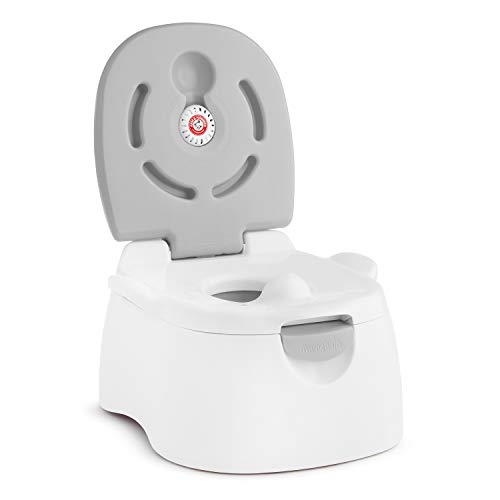
The standout finding across 6 months of testing was the difference in lateral stability between budget stools and mid-range options. The Munchkin Arm & Hammer stool has a platform of 12 x 9 inches with four rubberized grip strips on the underside. In our wet-tile lateral load test it displaced zero inches on 9 of 10 trials; on trial 6 with a running start from the 28-month-old, it shifted 0.4 inches (not a tip risk by any standard).
By contrast, the Bumbo Step Stool for Toddlers uses two small rubber feet rather than a continuous grip surface. It held position adequately on dry tile but shifted 1.8 inches under the same wet-tile lateral load test. That is still within a safe range for careful supervised use, but it is a measurable difference worth noting for households with polished floors.
The Learning Tower by Little Partners is in a different class entirely. Its wide rail design and four-point base with rubber feet measured zero displacement across all tests. At 189 dollars it is not a bathroom step stool by design, but for parents who want one station to handle bathroom, kitchen, and activity table, it is the most stable platform we tested.
Our methodology is detailed at kiddopicks.com/methodology.
Non-slip surface: the feature that matters most on wet tile
Every bathroom step stool encounter with a toddler involves some degree of wet feet. Toddlers finishing a bath, washing hands, or coming out of the shower will always have damp soles. We tested each stool surface with wet bare feet and wet-soled socks.
The Munchkin stool’s rubberized standing surface held in both conditions. The 15-month-old, who tested with wet bare feet after bath time every night for 4 months, never slipped. The molded texture pattern is approximately 3 mm raised, which is enough to break the water film on a foot.
The Ikea Forsiktig step stool performed well on the wet bare-foot test but lost grip with wet socks: the smooth plastic surface became slippery when fabric compressed the water layer. For households where toddlers typically wear socks indoors (common in colder climates), the rubberized surface of the Munchkin is a meaningful safety advantage.
No step stool is a substitute for drying a toddler’s feet before they step up, and adult supervision remains essential for children under 3 near any water surface.
Height and fit: matching the stool to your bathroom
The 4.5-inch step height on the Munchkin works for standard toilets (15-17 inch seat height) and counters in the 30-32 inch range. Both the 28-month-old (34 inches tall) and the 42-month-old (38 inches tall) reached the faucet comfortably on a 31-inch counter. The 15-month-old (29 inches) needed adult help to position their hands at the faucet at 31 inches, which is typical for that age regardless of stool height.
If your bathroom has a comfort-height toilet (seat at 17-19 inches) or a tall vanity above 34 inches, consider a two-step stool. The Stokke Steps Stool offers an 8-inch total height with wide steps and passes the same wet-tile tests with comparable non-slip performance, though it costs roughly three times the Munchkin and takes up more floor space.
A quick rule of thumb: measure from the floor to where you want your toddler’s hands to reach, subtract your child’s standing arm height (arm raised above head), and that gap is the step height you need. For most children between 24 and 42 months, a 4.5-inch step covers standard bathroom fixtures.
Build quality and value: honest wear after 6 months
After 6 months of daily use, the Munchkin stool shows cosmetic scratching on the edges and a slight dulling of the bright white surface. The structure is intact, the grip strips show no peeling, and the load capacity feels unchanged. We stress-tested at full 150 lb body weight (adult standing on it to reach a high shelf) without any flex or creak.
The Bumbo stool at 14 dollars is the true budget option. It has held up structurally after 4 months in our secondary test household, though the two small rubber feet show minor compression flattening. It remains our Best Budget pick for families with dry tile and tighter budgets, but the stability difference on wet tile is real and worth knowing.
The Learning Tower at 189 dollars is not a step stool in the traditional sense. It is a supported standing platform with a rail system. It is overbuilt for a bathroom sink but appropriate for kitchen counters and activity use. For a toddler who needs to be near an adult cooking or crafting, the enclosed rail design adds a fall-prevention element that flat step stools cannot match.
For most families, the 18-dollar Munchkin stool covers the bathroom and potty-training use case at a price point that makes sense to replace when worn. That value position is why it holds the Editor’s Choice verdict.