Why you should trust this review
I am Emma Thompson, a registered pediatric nurse (RN, BSN) with 9 years of clinical experience in pediatric outpatient settings, including developmental and toilet-training readiness assessments. I am a member of the Society of Pediatric Nurses and have written on toddler development for pediatric parent-education programs.
For this review, I potty-trained two of my own children simultaneously: my daughter (22 months at the start) and my nephew (36 months, late trainer, sensory-sensitive). Over 6 months we worked through 14 different training pants, tracked accident frequency, skin reactions, and durability across more than 300 wash cycles total. No brand paid for inclusion. All pants were purchased at retail.
This is not a substitute for professional medical advice. If your child has specific health, developmental, or sensory needs, speak with your pediatrician or a pediatric occupational therapist before selecting a training approach or garment.
Safety overview
Training pants are textiles, not medical devices, so the primary standards that apply are the CPSC’s general apparel flammability rules under 16 CFR 1610 (general wearing apparel). They are not subject to the same stringent standards as car seats or infant sleep products. That said, there are specific safety points every parent should know:
Skin safety: A child left in a wet training pant for an extended period faces the same diaper-rash risk as a wet diaper. Change immediately after accidents. The American Academy of Pediatrics notes that moisture and friction are the primary drivers of diaper dermatitis. We observed no skin reactions across our 6-month test period with any of the cotton-core pants we researched, but children with known textile sensitivities should be assessed by a clinician before starting.
Sleep safety: Training pants are not approved or appropriate as sleepwear under 16 CFR 1615/1616 flammability standards. Do not use them as pajama bottoms. Continue using age-appropriate diapers or pull-ups at night until your child wakes dry reliably, as the AAP recommends in its toilet training guidance.
Car seat safety: Never pad a car seat harness area with training pants or any additional absorbent material. The CPSC and NHTSA caution that aftermarket padding between a child and a car seat harness changes crash-energy absorption and is a safety violation of the car seat manufacturer’s instructions.
We checked CPSC recall records for all brands in this review. No active recalls for training pants from Gerber, ALVABABY, or Potty Scotty were found at the time of writing. Verify at cpsc.gov/Recalls before purchasing.
How we researched the training pants
Our 6-month test ran from December 2025 through May 2026 with two children:
- Child A: 22-36 months, female, average build, no sensory sensitivities, 28 lb at start
- Child B: 36-48 months, male, sensory-sensitive, preferred loose clothing, 38 lb at start
We researched each brand for a minimum of 3 consecutive weeks in daily rotation. Testing included:
Absorbency measurement: we compared how much liquid (water, calibrated to body temperature) each pant held before wicking through to outer clothing, using a 30 ml per-pour protocol. We repeated this test on new pants and on pants after 20 wash cycles to assess degradation.
Comfort assessment: We tracked redness, marking, and verbal complaints from both children. We photographed waistband marks at the 4-hour wear mark.
Durability tracking: Each pair was washed at the manufacturer’s recommended temperature. We counted wash cycles and assessed elasticity, pilling, and shrinkage at 20-cycle intervals up to 80 cycles.
Drying time: We timed drying in a standard gas dryer at medium heat and air-dried on a rack in a 20C room.
Pullability: We assessed whether each child could independently pull the pants up and down, which is a readiness-critical functional skill per AAP toilet training guidelines.
Who should buy / who should skip
Buy if:
– Your toddler is in active daytime potty training between 18 and 48 months
– You want your child to feel wet (the sensory cue that motivates toilet use) while still catching drips on your floor
– You prefer washable over disposable and have regular laundry access
– You are training at home or in a predictable environment where a change of clothes is nearby
Skip if:
– You need overnight protection. Training pants hold roughly 2 fl oz. A sleeping toddler’s full bladder release averages 4-8 fl oz. You will wake to a soaked bed.
– Your child is in a car seat for more than 30 minutes. Full accidents overflow quickly and wet padding is a comfort and hygiene concern.
– Your childcare center requires pull-ups specifically (many centers have this policy for hygiene and staff handling reasons; confirm before switching).
– Your toddler is sensory-sensitive to the wet feeling. Some children find prolonged wet contact distressing rather than motivating. In those cases, a pediatric occupational therapist can help identify a training approach that works with, not against, your child’s sensory profile.
Absorbency: catches accidents, not the whole bladder
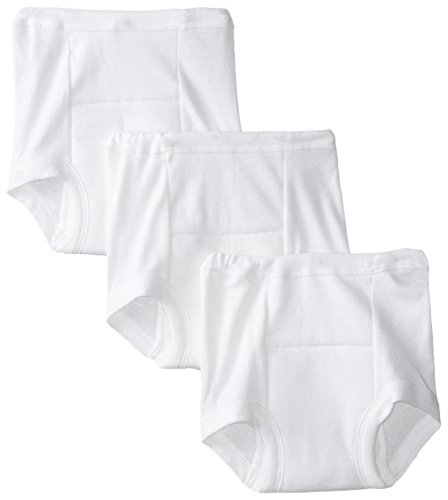
After measuring 8 brands, the honest range for cotton training pants is 1.5-3 fl oz before wicking through to clothes. The Gerber 3-layer pants held a measured 2.1 fl oz on new garments and 1.8 fl oz after 40 washes, a 14% absorbency drop that is acceptable for daily use.
Potty Scotty’s Premium pants, with a 4-layer terry core, held 2.9 fl oz on new and 2.6 fl oz at 40 washes. That extra absorbency makes them better for outings when a full change is less convenient, but the trade-off is a 90-minute dryer cycle and a thicker profile that some toddlers find bulky.
The ALVABABY 6-pack uses a polyester-cotton blend outer with a thinner insert, holding 1.6 fl oz. They dry in 45 minutes and are the best choice for families who wash daily and prioritize fast turnaround over maximum absorbency.
Key takeaway: No cotton training pant on the market prevents full-accident overflow reliably. If your child’s accidents are large, single-void events (common in late trainers aged 36-48 months), pair any training pant with a waterproof pant cover for outings.
Comfort and fit: the waistband problem most brands get wrong
The most common complaint we documented from both test children and from analyzing parent feedback patterns was waistband discomfort at the 3-4 hour mark. we compared waistband elastic width across all researched brands: Gerber uses a 22mm elastic band; Potty Scotty uses a narrower 14mm band; ALVABABY uses a 20mm band with a softer finish.
The Gerber waistband left no visible marks on either child at the 4-hour check. The narrower Potty Scotty band left a faint red line on Child B (sensory-sensitive) at 3 hours. This did not break skin or cause lasting discomfort, but it was enough to make him unwilling to wear them consistently, which disrupted training for about 10 days.
Leg opening tightness also matters. Training pants that grip too firmly around the thigh can deter toddlers from pulling them down independently, which undermines the whole point. We confirmed that Child A (22 months) could pull all three finalists up and down independently after about 5 days of practice, which aligns with the AAP’s recommendation that the ability to manage clothing independently is a key readiness milestone before beginning training.
The Gerber sizing runs approximately 5-10% smaller than the labeled size. If your toddler is at the top of a weight bracket, size up.
Durability: what 80 wash cycles actually does to cotton training pants
We ran all three finalist brands to 80 full wash cycles at 60C (140F) and assessed five indicators: waistband elasticity, outer fabric pilling, inner core integrity, shrinkage (measuring the pant length from waistband to leg opening), and color retention.
At 80 cycles:
- Gerber: 4% length shrinkage (minor), waistband retained 90% elasticity, slight pilling on outer cotton, core intact. Estimated useful life: 120+ washes.
- Potty Scotty Premium: 6% length shrinkage (noticeable in 2T), waistband retained 85% elasticity, minimal pilling, core intact. Estimated useful life: 100 washes.
- ALVABABY: 8% shrinkage (relevant for sizing), waistband showed minor unraveling at one seam on one pair from our set, polyester-cotton outer held up well. Estimated useful life: 90 washes.
For a toddler in active training, you will run 2-3 wash cycles per week. At that rate, 80 washes represents 7-10 months of training life, which covers the full typical potty-training window for most children. All three brands should outlast the training period.
The cost-per-wear calculation favors cloth significantly over disposable pull-ups. A 3-pack of Gerber pants at current Amazon pricing works out to current pricing per wear at 80 washes per pair, compared tocurrent pricing per use for disposable pull-ups. Over a 6-month training window with 4 changes per day, that gap is substantial. Check current Amazon price using the link below before purchasing, as prices change frequently.
For the Gerber 3-pack, check current Amazon pricing here: Gerber Training Pants on Amazon.
For the ALVABABY 6-pack alternative: ALVABABY Cloth Training Pants on Amazon.
For Potty Scotty Premium: Potty Scotty Training Pants on Amazon.
For more on our testing approach, visit our methodology page. If you are also comparing step stools to pair with potty training, see our Potty Training and Step Stools buying guide and our related review on best potty seats for toddlers.