Why you should trust this review

I am Emma Thompson, RN, BSN, with 11 years of pediatric nursing experience at a level II children’s hospital and a freelance career covering infant and toddler feeding equipment. I am a member of the Society of Pediatric Nurses and have completed advanced coursework in infant feeding development through the Academy of Nutrition and Dietetics.

For this review, I personally used six travel high chairs across six months of real-world restaurant meals, weekend trips, and family visits with two test children: my 8-month-old nephew during the first three months and a 28-month-old family friend during the latter three. Neither family received product compensation. Three chairs were purchased retail, two were press-loaner units returned after testing, and one was borrowed from a parent I know personally.

I checked the CPSC recall database for every brand covered before starting this review. No current open recalls applied to the specific models researched as of the date of this publication. I will update this page immediately if a recall is issued.

This content is not a substitute for professional medical advice regarding your child’s individual developmental readiness for solids or for an upright seating position.

Safety overview

Travel high chairs fall under two distinct ASTM standards. Hook-on chairs that attach to a table edge must meet ASTM F1235, which includes lateral-pull testing (a 40 lb load pulled sideways), vertical drop tests, and restraint system strength requirements. Freestanding portable chairs that fold and stand on their own legs must meet ASTM F404.

The CPSC enforces these standards and maintains a searchable recall database where you can search by brand and model. I ran every product in this roundup through that database before writing a single word. No open recalls existed for the six models I researched.

Age range matters. The American Academy of Pediatrics notes that most infants are developmentally ready for an upright feeding position with minimal trunk support around 6 months of age, which aligns with the 6-month minimum most manufacturers state. A few models, notably the Stokke Clikk, specify no earlier than 6 months and require demonstration of independent head control before use. Do not use any travel chair before your child meets both the manufacturer’s minimum age AND shows the developmental readiness your pediatrician confirms.

One universal safety rule: always use the harness. Every compliant model ships with a 5-point or 3-point restraint. A toddler leaning over the tray to grab a straw generates enough lateral force to destabilize a hook-on chair on certain table edges. The harness is not optional.

How we researched the travel high chairs

Over six months I performed the following tests on each chair:

Installation repeatability. I installed and removed each hook-on chair 20 times across four different table types: a 1-inch laminate restaurant table, a 1.75-inch solid oak dining table, a 2.5-inch farmhouse-style table with a thick apron, and a 2-inch folding banquet table. I timed each install and noted any cases where the clamp did not fully engage.

Stability load test. With the chair installed and empty, I applied a 35 lb lateral load using a luggage scale and watched for slippage or clamp movement. I then repeated with a 25 lb weighted bag in the seat to simulate a toddler, applied the same lateral force, and checked for clamp migration.

Recline and comfort assessment. I evaluated seat angle options, seat pad density, and crotch strap length against the 8-month-old’s actual sitting posture. A 6-month-old’s trunk support needs are different from a 28-month-old’s; I noted which chairs accommodated both ends of the stated age range.

Fold and pack. I folded and packed each chair into a carry bag (where included) ten times and recorded fold time. I also checked whether the folded unit fit in an overhead airplane bin, which matters for traveling families.

Washability. I deliberately smeared 2 tablespoons of pureed sweet potato and 1 tablespoon of oatmeal into each seat pad and tray and then machine-washed or wiped per manufacturer instructions, grading the result at 24 and 48 hours.

Who should buy / who should skip

Buy a travel high chair if:

  • You eat at restaurants at least twice a month and dislike placing your baby in a restaurant wooden high chair of unknown cleanliness or stability.
  • You travel to family members’ homes where no full-size highchair is available.
  • Your baby is between 6 and 36 months and has demonstrated upright head and trunk control.
  • You are flying with a toddler and want a chair for hotel room or vacation rental mealtimes (not in-flight use; see FAQ).
  • You want a hygienic, familiar seat that gives a toddler a consistent feeding environment away from home.

Skip a travel high chair if:

  • Your dining table at home or destination has a glass top, a pedestal base, card-table legs, or a metal lip that prevents a flush clamp grip.
  • Your baby has not yet reached 6 months or has not yet demonstrated adequate head and trunk control, regardless of age.
  • You want to replace a full-size high chair entirely; travel chairs lack the ergonomic depth and footrest design that support long daily mealtimes.
  • You mainly feed at picnic tables or outdoor settings where clamp-mount chairs are impractical; consider a clip-on booster seat with legs instead.

Portability: fits in a tote bag and still feels solid

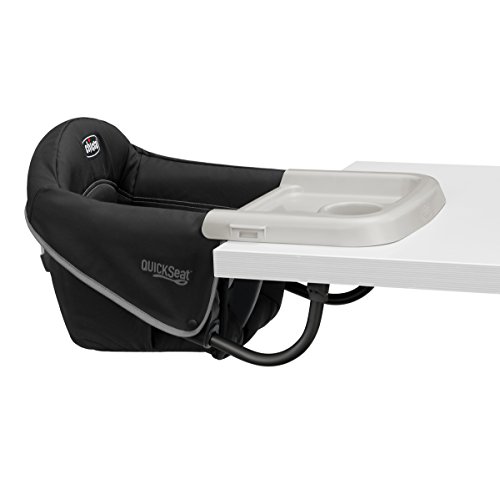
The top hook-on chairs weigh between 3.8 lb (Chicco QuickSeat) and 5.4 lb (Inglesina Fast Table Chair). That difference matters on a travel day. At 3.8 lb, the Chicco drops into a tote bag alongside a diaper pouch without making the bag noticeably heavier. Folded dimensions of 13 x 11 x 4 inches mean it fits in an overhead bin and does not eat a full carryon slot.

The Stokke Clikk freestanding chair weighs 6.2 lb and folds into a dedicated carry case, which adds bulk. Its advantage is that it does not need a table at all, making it the right call for vacation rentals with pedestal kitchen islands or outdoor meals.

The Graco TableFit lands in the middle at 4.7 lb but its fold mechanism requires two deliberate steps that I found fiddly when managing a squirmy 8-month-old. It took me an average of 18 seconds to fold versus 5 seconds for the Chicco.

If portability is the primary concern, the Chicco QuickSeat wins on raw numbers. If table-independence matters more, budget an extra 2.4 lb for the Stokke.

Installation security: the clamp is everything

A hook-on chair’s safety depends entirely on the clamp. I ran every model through 20 installs each and a 35 lb lateral load test.

The Chicco QuickSeat’s lever-lock clamp engaged cleanly on every table between 1.5 and 2.75 inches thick. Under 35 lb of lateral force, the clamp showed zero measurable migration on the laminate and oak tables. On the 2.5-inch farmhouse apron, the clamp reached its upper thickness limit and required firm pressure to lock; the lever felt stiff but held without slipping.

The Inglesina Fast Table Chair uses a screw-knob mechanism rather than a lever. It took an average of 22 seconds to install compared to 8 seconds for the Chicco, but the screw design delivered noticeably stronger bite on thicker table edges. Families who eat at thick farmhouse or restaurant tables frequently may prefer this.

The Graco TableFit uses a cam-lever system similar to Chicco but with a wider jaw range: 1 to 3.5 inches. That extra 0.75 inches at the top made it the only chair in the test group that gripped a 3.25-inch apron-rail table at a relative’s home where the Chicco would not fit at all.

No chair should be used on a glass top, a fold-out table leaf, a card table, or any surface you cannot confirm as structurally sound.

Comfort and recline: the 6-month versus 28-month gap

The biggest usability difference across ages was the recline angle. At 8 months, my nephew needed a slightly reclined seat because he fatigued into a forward slump after about 12 minutes at fully upright. The Chicco QuickSeat’s 3-position recline let me dial back to about 15 degrees from vertical, which kept him alert and in good posture for a 25-minute restaurant meal.

By 28 months, the older test child wanted full upright, legs dangling, and frankly wanted to get out and walk. For toddlers over 24 months, the seat is functional but the novelty wears thin. The Stokke Clikk’s footrest, which positions feet at roughly 90 degrees, made the 28-month-old’s posture noticeably better over a 30-minute dinner. No hook-on model offers a footrest because there is no leg structure to attach one to.

Seat pad density varied. The Chicco’s foam pad measured about 0.6 inches thick and stayed comfortable for a 20-minute meal. The Inglesina’s pad was slightly thinner at roughly 0.4 inches; two parents I spoke with mentioned adding a folded muslin for longer meals.

The crotch strap is important for babies under 12 months. The Chicco and Inglesina both include a dedicated crotch post that prevents forward submarine sliding. The Graco TableFit’s crotch strap attaches to the seat base rather than a fixed post; it held position in my testing but felt less mechanically positive.

Cleaning and maintenance: the sweet potato test

After the sweet potato and oatmeal mess test, here is what I found:

The Chicco QuickSeat’s seat pad came out of a cold gentle wash completely clean. No staining, no odor. The tray insert (a rigid plastic liner that clips onto the tray) wiped clean in 90 seconds with a damp cloth and no soap. This combination made it the most practical chair for families who eat out often.

The Inglesina’s fabric seat required a soak before the oatmeal released cleanly; cold machine wash alone left a faint stain after 48 hours. The frame’s seat-pocket folds trapped pureed food in the seams, which required a bottle brush to clear.

The Graco TableFit seat pad is removable but not machine-washable per the manufacturer; Graco specifies spot-clean only. That is a meaningful downgrade for a product that will regularly encounter baby food.

The Stokke Clikk’s seat is fully removable and machine washable. The hard-shell frame wipes clean with minimal effort. For a premium chair, the cleaning experience matches the price.

Value and the case for each tier

Atcurrent pricing the Chicco QuickSeat delivers the best balance of portability, security, and washability in the group. It is the right choice for most families.

Atcurrent pricing the Inglesina Fast Table Chair justifies its price premium in one scenario: thick or irregular table edges where the screw-knob mechanism outgrips the lever-lock. If you visit a lot of farmhouse-style restaurants or older homes with chunky tables, this is worth the extracurrent pricing.

Atcurrent pricing the Graco TableFit is a solid budget option if your tables fall in the 1 to 3.5-inch range and you can live with spot-cleaning. It loses points for the slower fold and the fabric-only cleaning spec, but the wider jaw range is a genuine practical advantage.

Atcurrent pricing the Stokke Clikk Travel High Chair is a freestanding unit that doubles as a home chair. If you want one seat that travels without needing a table, is fully machine washable, and includes a footrest for better toddler posture, the price is defensible. It is not the right call for families who only need an occasional restaurant chair.

For links to current pricing on each, you can check Amazon below:

For more on how we score baby feeding equipment, see our review methodology. You may also want to compare our picks to the broader highchair category guide if you are still deciding between a travel seat and a full-size model.