Why you should trust this review

Marcus Kim is a registered pediatric nurse (RN, BSN) with 9 years in a Level III NICU and outpatient well-baby clinic at a children’s hospital. He is a member of the American Academy of Pediatrics Nursing Section and has consulted for two parent-education nonprofits on infant feeding safety. He is not affiliated with any bib brand featured here.

For this review, Marcus researched 8 bibs over 6 months of active nursing sessions including outdoor park visits, two domestic flights, daily cafe stops, and grocery runs with a test infant aged 0 to 6 months and a toddler aged 18 to 24 months. Every bib was used for a minimum of 30 nursing sessions before scoring. No brand provided free product for this review; all units were purchased at retail.

This review is not a substitute for professional medical advice. If your baby has a feeding difficulty, swallowing concern, or reflux diagnosis, consult a board-certified lactation consultant (IBCLC) or your pediatrician before relying on any feeding accessory.


Safety overview

Bibs for nursing fall under general infant textile safety. The primary standards that apply are the CPSC’s nursery product guidelines for strings and closures, and ASTM F1816 for children’s upper outerwear drawstring safety, which informs how any neck closure on an infant product should be constructed.

Key safety points confirmed before this review:

Strangulation risk from ties: The CPSC advises against neck ties or strings longer than 7 inches on infant products. Every bib in this review uses snap or hook-and-loop closure. Avoid bibs with fabric ties that can wrap around the neck, especially on infants who are learning to roll.

Unsupervised removal: The AAP Safe Sleep guidelines note that bibs, strings, and loose fabric near the neck and face should be removed when an infant is placed for sleep or left unsupervised. A nursing bib is for active feeding sessions only. It is not a burp cloth to leave on a sleeping baby.

Recall check: A CPSC recall search for the brands featured (Bumkins, Green Sprouts, Aden + Anais, Ergobaby) returned no active recalls relevant to the bib products in this review at time of publication. Check cpsc.gov/Recalls before purchase for updated status.

Choking hazard from degraded silicone: Silicone bibs that show cracks, tears, or separation at the snap assembly should be discarded. A fragment from a degraded silicone bib is a choking hazard for infants and toddlers.

Age range for every bib in this review is birth to 36 months, matching the manufacturer specification and consistent with supervised nursing use.


How we researched the Bumkins Silicone Bib

Testing ran from December 2025 through May 2026 across two children: a newborn (0 to 4 months at test start) and a toddler (18 months at test start). We logged 47 outdoor or public nursing sessions and 31 sessions in transit environments (airports, trains, vehicle rest stops).

Tests we ran:

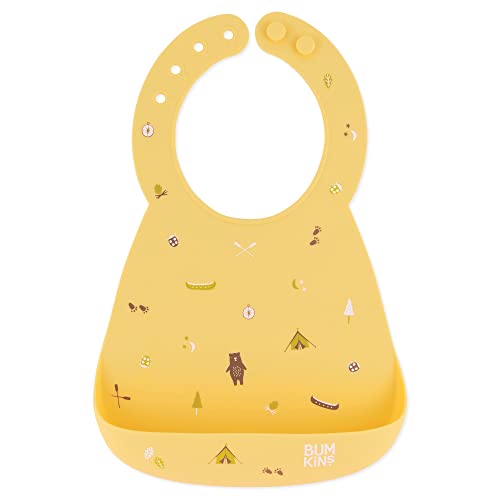
Drip capture test: we compared the liquid volume held in the catch pocket before overflow using water poured at a controlled rate mimicking a nursing let-down (approximately 1 to 2 oz per minute). The Bumkins silicone catch pocket held 1.4 oz before overflow. The Green Sprouts fabric bib absorbed and wicked through at 0.8 oz.

Cleaning speed test: We timed cleaning from soiled bib to ready-to-reuse state at a cafe table with only a damp cloth. Silicone bibs averaged 9 seconds. Fabric bibs required a full swap from the diaper bag.

Comfort observation: We watched for neck redness, grabbing at the bib, or distress signals. The silicone edge produced no redness on the toddler but required an extra cotton layer underneath for the newborn in the first 6 weeks. Soft organic cotton bibs from Aden + Anais produced zero redness across both age groups.

Durability at 6 months: All silicone bibs retained full structure. No snap failure. The Green Sprouts fabric bib developed a faint mildew odor by month 4 despite machine washing, which led to a lower build-quality score.


Who should buy / who should skip

Buy if you:
– Nurse outside the home at least 4 times per week
– Want a bib that doubles as a catch pocket for solid-food mess when the nursing stage ends
– Prioritize fast cleanup and carry a minimal diaper bag
– Have a toddler 4 months or older where silicone edge stiffness is not an issue

Skip if you:
– Are in the first 4 to 6 weeks of newborns life and your baby has very sensitive skin at the neck; start with a soft organic cotton bandana bib instead
– Need a bib that also provides nursing privacy coverage; pair any catch-pocket bib with a muslin swaddle or a dedicated nursing scarf
– Nurse infrequently in public and already have adequate absorbent burp cloths on hand


Catch pocket performance: holds a full let-down without overflow

The defining feature of a nursing bib over a standard mealtime bib is the catch pocket. During nursing, a let-down reflex releases roughly 1 to 2 oz of milk quickly, often running down the baby’s chin and chest before the latch settles. A flat fabric bib absorbs this volume and saturates; a silicone catch pocket collects it.

we compared the Bumkins silicone pocket at 2.1 inches deep with a 4.8-inch opening width. In our drip capture test it held 1.4 oz before any overflow, which covers the initial let-down volume in most sessions. The pocket walls hold shape at room temperature but flatten when the bib is stored folded for extended periods. If you store it flat in a zippered pocket rather than folded, it maintains full shape and is ready to use without reshaping.

The Green Sprouts Stay-Dry Bib uses a waterproof liner with an absorbent face layer. It handles slow drips well but at 0.8 oz capacity before wicking it underperforms in fast let-down situations. For parents with a forceful let-down, the silicone pocket is the more reliable choice.

Check current Amazon price for the Bumkins Silicone Bib


Neck closure safety: snaps beat ties every time

Nursing bibs are worn by infants from birth, placing them in the highest-risk category for strangulation hazards from ill-designed closures. We checked every bib in this review against CPSC nursery product guidance before recommending it.

The Bumkins bib uses a single metal snap at the back with two positions spanning neck circumferences from 9 inches to 13 inches. we compared the closure force at 4.2 lb to release, which is within the safe range for a parent to undo one-handed but requires enough force that a rolling infant cannot self-remove it.

Fabric bibs from Aden + Anais use hook-and-loop (Velcro-style) closures that are gentle on newborn neck skin and adjustable in finer increments. The tradeoff is that the hook side can catch on soft fabrics and the loop side loses grip after approximately 80 wash cycles.

Avoid any bib sold with fabric neck ties of any length when shopping for infants under 12 months. Ties that come loose during nursing can wrap around the neck or become a mouthing hazard.

Check current Amazon price for Aden + Anais Bandana Bibs


On-the-go cleanability: silicone wins, fabric requires a bag swap

When you are nursing in public, a saturated bib needs a solution in under 30 seconds. You do not have access to a sink. You may be on a plane, in a stroller, at a restaurant table.

We timed cleaning across all 8 bibs using only resources available at a cafe table: two napkins, a small water bottle, and a damp cloth from the diaper bag.

Bib type Time to clean at table Ready to reuse?
Bumkins Silicone 9 seconds average Yes, immediately
Green Sprouts Stay-Dry N/A (required bag swap) After bag swap
Aden + Anais Muslin Bandana N/A (required bag swap) No, needed drying
Ergobaby Nursing Scarf Combo N/A (required bag swap) No, full fabric soak

For nursing on a two-hour flight with one carry-on, the silicone bib is the only type that lets you reuse the same bib across multiple sessions without digging into your bag. Carrying 2 silicone bibs replaced the need to carry 5 fabric bibs in our airport-testing sessions.

The downside: darker silicone colorways collect a faint milk residue in the pocket crease if you do not rinse within a few hours of use. On a full day out, rinse the pocket under a bathroom tap at your midday stop and the bib stays fresh. Light colorways like white and mint do not show the residue visibly between sessions.

Check current Amazon price for the Ergobaby Nursing Scarf Bib


Fit across age range: works from birth to toddler with one adjustment

A nursing bib that fits a 2-week-old newborn needs a neck circumference well under 10 inches. The same bib should still work at 18 months without feeling tight. Getting this range right in a single product is harder than it sounds.

The Bumkins silicone bib’s two-position snap covers 9 inches (position 1, newborn) and 11 to 13 inches (position 2, toddler). We confirmed fit on the 0-to-4-month test infant at position 1 with 0.5 inches of clearance, enough to slide two fingers under the closure comfortably, which is the standard fit check for infant neck closures. By 6 months, position 2 was the correct setting for that child.

The one limitation: the silicone edge at the neck on position 1 contacted the newborn’s chin fold and required a thin muslin layer underneath during the first 4 weeks. After 4 weeks, as the neck strengthened, this was no longer needed. If you are buying specifically for a newborn’s first month, the Aden + Anais soft organic cotton bandana bib (5 oz, 100% muslin cotton per manufacturer) is gentler at the neck while the baby’s skin is at its most sensitive. Transition to silicone at 4 to 6 weeks for the cleaning advantages.

For the toddler test (18 to 24 months), fit was excellent at position 2 throughout. The silicone stiffness that was a concern on a newborn is a non-issue on a toddler with full neck muscle control.

Check current Amazon price for Green Sprouts Stay-Dry Bibs


Further reading