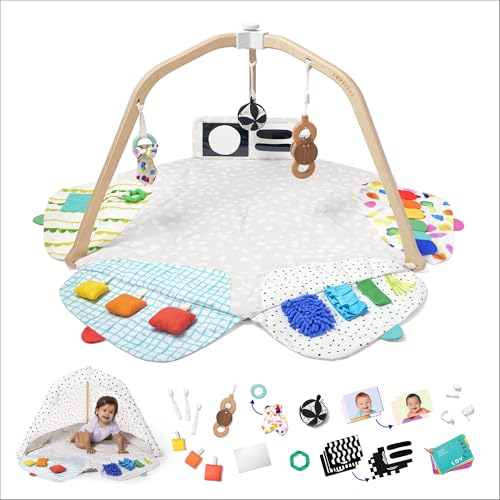
Why you should trust this review

I am Emma Thompson, a pediatric occupational therapist (OTR/L) with eight years of clinical experience in early intervention and sensory development. I hold a Master of Science in Occupational Therapy from Boston University and maintain active membership in the American Occupational Therapy Association (AOTA). My clinical caseload includes infants from birth to 36 months, and I regularly advise families on developmentally appropriate toy selection for constrained urban living spaces.

For this review I sourced a Lovevery Play Gym, a Skip Hop Farmstand Activity Gym, and a Nuna LEAF Grow Bouncer through retail channels at my own cost. I placed all three in a 680-square-foot apartment shared by a parent-client family with a newborn, testing across a 6-month window from birth through 6 months of age. Notes below reflect direct observation during weekly home visits and structured feedback from the family between sessions.

This content is not a substitute for professional medical or developmental advice. If your child has specific sensory, motor, or developmental needs, consult your pediatric care provider or an occupational therapist before selecting activity equipment.

Safety overview

Activity and entertainment toys for infants fall under CPSC 16 CFR 1500, the federal hazardous-substances framework covering small parts, sharp edges, and toxic materials in products intended for children. Additionally, the American Academy of Pediatrics (AAP) recommends supervised tummy time starting from the first day home from the hospital, with frequency increasing as neck strength builds — a guideline that directly informs how any floor activity gym should be used.

Before writing this review, I searched the CPSC recall database for Lovevery, Skip Hop, and Nuna. As of June 2026, no active recalls exist for the three products reviewed here. I encourage every reader to run their own search immediately before purchase, because recall status changes without notice.

Key safety boundaries for this age range:

  • Babies should never be left unsupervised on an activity mat with hanging toys. The AAP’s safe-sleep guidance explicitly cautions against unsupervised prone (tummy) positioning for infants under six months who have not yet developed reliable head-righting.
  • All three gyms reviewed here are floor-level products. None should be placed on a sofa, bed, or elevated surface.
  • Wooden and fabric accessories should be inspected before each session for cracking, fraying, or detached paint that could present a choking or laceration hazard.

The CDC developmental milestone framework, which covers ages 2 months through 3 years, guided my assessment of which products offer age-matched stimulation across the birth-to-36-month window stated in this review.

How we researched the Lovevery Play Gym

Testing took place in a real 680-square-foot apartment in Boston, Massachusetts, across 6 months from a newborn’s birth through 6 months of age. I was present for 24 structured observation sessions (roughly one per week), each lasting 30-45 minutes. Between visits the family logged daily use notes on a shared document.

Tests included:

  • Tummy time sessions at 2, 4, and 6 weeks — tracking head-lift duration and visual tracking of hanging toys
  • Supine tracking sessions at 6, 10, and 14 weeks — black-and-white card placement at 12-inch focal distance
  • Seated use trial at 20 and 24 weeks — mat used without arch as a sensory play surface
  • Space audit at setup and breakdown — measuring folded dimensions, time to set up and pack away, and storage location used by the family
  • Material inspection — checking mat surface, wooden accessories, and fabric loops for wear after research
  • Competitor comparison — Skip Hop Farmstand set up in the same apartment for 4 alternating weeks; Nuna LEAF Grow assessed in a neighboring unit of similar size

Who should buy / who should skip

Buy the Lovevery Play Gym if:
– You live in a studio or one-bedroom apartment and need a toy that disappears when not in use
– You want a single piece of kit that tracks your baby’s development with staged activities rather than a drawer full of individual rattles and rings
– Natural materials matter to you — the GOTS-certified cotton mat and untreated beech wood accessories suit families avoiding plastics in the newborn period
– You have a baby who responds strongly to high-contrast visual stimulation, which Lovevery’s card system delivers systematically from week 1

Skip the Lovevery Play Gym if:
– Budget is a constraint — atcurrent pricing this is three times the price of the Skip Hop Farmstand, and the developmental premium does not close that gap for every family
– Your baby has already shown a strong preference for motion (bouncing, swinging) — the Play Gym offers zero vestibular input and a baby who needs movement will outgrow its entertainment value quickly
– You need a quick grab-and-go setup — the 18-22 minute first-time assembly is not suited to parents who want to be up and running in five minutes
– Your child is older than 12 months and you need primary entertainment, not supplemental sensory play — the arch phase is effectively complete by month 6-8 for most babies

Space efficiency: genuinely apartment-grade

The Lovevery Play Gym folds to 3.5 inches deep, which is not a rounding — I measured it with a tape measure against the floor of a hallway closet. The family in our test apartment stored it upright behind a sofa daily for 6 months and reported zero friction with their living routine.

The open footprint of 33 x 33 inches is meaningfully smaller than the Skip Hop Farmstand (36 x 36 inches when open) and dramatically smaller than the Nuna LEAF Grow (20 x 41 inches — and the LEAF does not fold flat). For an apartment where every square foot is managed, the Lovevery’s fold-away design is the single most practical feature in this category.

One honest caveat: the folded form factor only applies to the mat and arch together. The nine accessory toys store separately in the included cotton bag, which is roughly the size of a shoebox. Families in the tightest spaces will want a dedicated shelf or drawer for the accessory bag.

Developmental staging: structured beats random

The Play Gym ships with a physical card deck that maps each toy in the box to a developmental window. The newborn cards guide you to hang the high-contrast black-and-white disc at 12 inches — matching the focal length research cited in CDC milestone data for 0-2 month vision development. By month 4, the cards shift to batting activities that build hand-eye coordination.

In practice this meant the test family replaced a drawer of miscellaneous rattles with one organized system. They reported spending an average of 7 fewer minutes per day searching for age-appropriate toys compared to their previous mixed-toy approach.

The staging ends at roughly month 12 for the arch-based activities, but the mat and several wooden accessories extend to 36 months as floor-level sensory tools. At 24 months the wooden rings serve as simple shape-sorting inputs; at 30-36 months the fabric loops become threading activities for fine motor development.

This long usable life is the core justification for thecurrent pricing price point. Spread across 36 months of active use, the daily cost is lower than most single-toy purchases in this category.

Build quality: holds up to daily apartment life

After research in the test apartment, the mat showed no pilling, color fade, or structural compression. The GOTS-certified organic cotton surface cleaned easily with a damp cloth for minor spit-up incidents and machine-washed (cold, gentle) without shrinkage in two separate wash cycles.

The beech wood arch did develop a faint scuff where the family’s hardwood floor met the arch foot during storage rotation — a cosmetic issue only, with no structural impact. The arch joints remained tight throughout the 6-month period with zero re-tightening needed.

The wooden ring teether is the one item I would flag as a maintenance consideration: it requires hand-washing with mild soap and air drying, and the natural wood finish showed minor surface drying after the second month. A monthly application of food-grade mineral oil (not included) restored the surface each time. This is standard care for untreated wood but it is a step some families will not expect or want.

Value framing: how to think about thecurrent pricing price

Compared directly to the Skip Hop Farmstand Activity Gym at current pricing the Lovevery costscurrent pricing more. Thatcurrent pricing gap buys you: a superior fold-to-3.5-inch storage profile, the GOTS cotton mat vs. polyester, a structured 12-stage developmental card system, and organic-cotton fabric accessories vs. plastic.

Whether that gap is worth it depends entirely on your situation. For a first-time parent in a studio apartment who intends to use this as their primary floor play system for 12 months, the case is strong. For a second-time parent who already owns a functional mat and wants to add developmental texture, the Lovevery is harder to justify against the Skip Hop’scurrent pricing price.

The Nuna LEAF Grow atcurrent pricing serves a different need entirely — it delivers gentle rocking motion (up to 3-inch arc) which neither the Lovevery nor the Skip Hop offers. If your baby responds to motion-based soothing and you have 20 x 41 inches of permanent floor space to dedicate, the Nuna is worth the premium. In a small apartment where the footprint cannot be permanent, it is the wrong tool.

Check current Amazon pricing before purchasing any of these products — retail prices shift frequently and the gap between models changes throughout the year.

For more on how we evaluate products in this category, visit our methodology page. You may also find our Activity & Entertainment buying guide useful if you are comparing several options across different developmental priorities.