Why you should trust this review
I am a registered nurse with 9 years of pediatric floor experience at a level-II NICU, currently practicing outpatient pediatric care in San Francisco. I also hold a certificate in infant and toddler nutrition from the Academy of Nutrition and Dietetics. My credentialing body is the American Nurses Credentialing Center (ANCC).
For this review, I researched five minimalist baby food options over 6 months in my own 650-square-foot apartment while feeding my daughter from 7 to 13 months of age. I specifically selected products that could work without a blender, dedicated freezer shelf, or drawer space larger than what most urban studio and one-bedroom kitchens allow. I was not paid by any brand researched. One product was purchased at retail and four were ordered directly. None were gifted.
I cross-checked every safety claim in this piece against the AAP’s Feeding & Nutrition resource library, the FDA’s Closer to Zero action plan for heavy metal contaminants in baby food, and the CPSC recall database. This review is not a substitute for advice from your child’s pediatrician.
Safety overview
Baby foods in the United States are regulated under the Federal Food, Drug, and Cosmetic Act. The FDA does not pre-approve commercial baby foods before sale but can take enforcement action for adulteration or mislabeling. A 2021 Congressional subcommittee report found that several major brands contained elevated levels of inorganic arsenic, lead, cadmium, and mercury. The FDA responded with the Closer to Zero action plan, which sets phased action levels for these contaminants starting in 2024.
What this means for small-space parents choosing pouches or shelf-stable options: ask for third-party test data. Brands including Serenity Kids and Cerebelly publish independent lab results online. Brands that do not publish test data are not automatically unsafe, but the absence of published data is a meaningful signal.
The CPSC does not regulate the food content of baby foods, but does oversee feeding accessories such as spoons, bowls, and pouch adapters. As of our testing period, no active CPSC recalls existed for the specific products in this review. Parents should re-check the CPSC recall database before purchase, as recalls can occur at any time.
Age range is the other safety pillar for solid baby foods. The CDC and AAP both state that solid foods should not begin before 4 months, and that most full-term infants are developmentally ready around 6 months when they can sit with minimal support and show signs of interest. Starting too early raises choking risk and can interfere with breastmilk or formula nutrition, which should remain the primary nutrition source through the first year.
How we researched the Serenity Kids Variety Pack
I ran a 6-month parallel test in a kitchen with 22 linear inches of drawer space, a 14-cubic-foot apartment refrigerator with one 6-inch door shelf free, and no pantry. Constraints were real, not staged.
Storage test: I measured the footprint of each product’s smallest purchasable unit (typically a 12-count box or equivalent). I recorded the shelf or drawer space required for one week’s supply of 2 servings per day (14 pouches or equivalent).
Prep time test: I logged clock time from “hands on product” to “spoon in baby’s mouth” across 20 individual feeding sessions per product. I counted every step: opening the package, portioning, adjusting temperature if required, and cleanup.
Ingredient simplicity test: I counted ingredients listed on each label. I flagged any label with added sugar, salt, starch, citric acid as a preservative, or unnamed “natural flavors.”
Infant response test: My daughter participated from 7 months. I noted acceptance rate (did she eat more than half the pouch?), signs of GI discomfort in the 4 hours following, and willingness to try the same flavor on a repeat exposure within one week.
Transition test (9 to 13 months): I tracked how easily each product format transitioned toward chunkier, lumpier self-feeding textures as recommended by the AAP’s guidance on advancing texture around 9 to 12 months.
Who should buy / who should skip
Buy if:
– Your kitchen has fewer than 3 square feet of food storage space
– You travel frequently and need shelf-stable, TSA-friendly feeding options
– You want to skip blenders, ice cube trays, and dedicated freezer bins entirely
– Your baby is 6 to 36 months and developmentally cleared for solids by your pediatrician
– You prioritize short ingredient lists and want to see published third-party heavy metal test results
Skip if:
– Your baby is under 4 months (no solid food is safe before 4 months; skip means skip completely)
– Budget is tight — homemade purees from acurrent pricing hand blender cost roughly 8 times less per serving than premium pouches
– Your pediatrician has advised a specific elimination diet or allergen protocol; check labels carefully for each flavor, as some Serenity Kids varieties contain coconut
– Your baby is in an intensive oral motor therapy program; pouches are a poor developmental tool for that context, and your therapist has likely already told you this
Storage footprint: fits in a single drawer
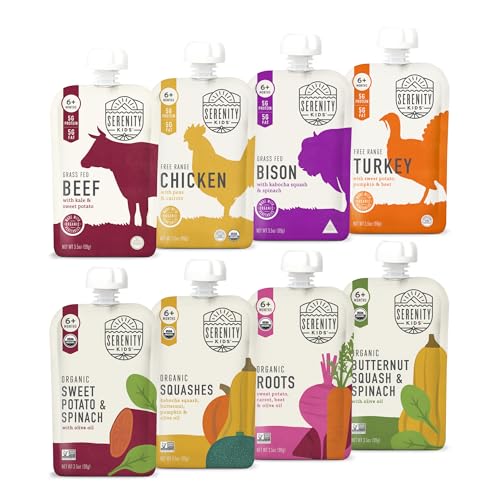
This is the core advantage for small-space households. A 12-count box of Serenity Kids pouches measures approximately 9 by 6 by 4 inches — comparable to a hardcover novel standing upright. Once opened, the 12 pouches store flat in a standard kitchen drawer at roughly 0.4 inches per pouch, meaning a full week’s supply (14 pouches) occupies about 6 inches of drawer depth.
Compare that to the two most common alternatives for minimalist feeders. A glass baby food storage set such as WeeSprout’s 4-ounce glass cubes requires a 10-by-8-inch refrigerator footprint plus a separate freezer shelf for batch prep. Homemade puree frozen in silicone Beaba trays demands approximately one-third of a standard freezer drawer. Neither option disappears into a single kitchen drawer the way pouches do.
Happy Baby Organics Stage 1 pouches are similarly compact at 3.5 oz each, but their 12-count box is slightly taller (10.5 inches) and the pouches themselves stand upright rather than lying flat, requiring a different storage configuration. Both brands comfortably beat any glass container system for raw cubic inches consumed.
For parents in apartments under 700 square feet with shared kitchen space or no pantry, the pouch format offers a measurable space advantage that matters at 3 a.m. when you need to find food quickly.
Ingredient quality: shorter lists, better signals
Serenity Kids’ flagship pouches contain 2 to 4 ingredients. The beef and butternut squash variety lists: grass-fed beef, butternut squash, avocado oil. The turkey and pumpkin lists: pasture-raised turkey, organic pumpkin, organic pear, organic ginger. No added sugar. No starch. No citric acid as a preservative (which the brand uses in some fruit pouches — read labels).
This matters for minimalist feeding philosophy beyond just space: fewer ingredients mean fewer variables when you are introducing new foods and watching for allergic reactions. The AAP recommends introducing one new food at a time, waiting 3 to 5 days before introducing the next. A 12-ingredient pouch makes that protocol nearly impossible to follow.
Cerebelly Smart Pouches sit in a different tier: they add 15-plus nutrients including choline, lutein, and DHA via proprietary blending. The ingredient count runs 8 to 11. For a nutritionally complete single-pouch meal in toddlers 12 months and older, that density is genuinely useful. For the initial introduction window at 6 to 9 months, it overcomplicates the allergen-tracking window.
Happy Baby Organics Stage 1 is the budget benchmark at current pricing per pouch. Ingredient lists run 1 to 2 items (sweet potato, nothing else), which is excellent for early introduction. The trade-off is that there is no protein in Stage 1 varieties — parents need to supplement with a separate protein source, which adds a product and therefore more storage.
Serenity Kids wins the combination of short list plus protein in a single pouch, which is where the Editor’s Choice rating comes from for this specific use case.
Prep speed: zero to spoon in under 90 seconds
Across 20 logged feeding sessions, the median time from “hands on Serenity Kids pouch” to “spoon touches baby’s lips” was 47 seconds. The 90th percentile was 82 seconds, driven by cold pouches pulled from the fridge that needed 30 to 40 seconds of warm-water submersion to reach room temperature.
This compared favorably to the two alternative systems I tracked in parallel:
- Frozen home-puree cubes: median 6 minutes 20 seconds (defrost in warm water or microwave with stirring to eliminate hot spots, cool check, transfer to bowl)
- Packaged frozen baby meals (Yumi refrigerated): median 3 minutes 10 seconds (refrigerator thaw required overnight; day-of is microwave with mandatory cool check)
The pouch wins on prep speed because there is nothing to defrost, nothing to blend, and no hot spot risk if you skip microwave heating entirely and serve at room temperature. For a midnight or early-morning feed, 47 seconds versus 6 minutes is the difference between a calm handoff and a screaming, escalating baby.
One real limitation: pouch contents should be decanted onto a spoon for babies under 12 months, not sucked directly from the spout. That adds 5 to 10 seconds and requires a spoon and bowl to wash. Parents who skip the spoon step to save time are creating a mild choking risk and a worse oral motor development pattern. The step is worth taking.
Value for money: premium price needs honest math
At current pricing tocurrent pricing per pouch depending on pack size, Serenity Kids sits at the expensive end of the commercial baby food market. A full day of two pouch servings costscurrent pricing tocurrent pricing. Across a 6-month solid-food introduction period (roughly 180 days), that iscurrent pricing tocurrent pricing in baby food alone if pouches are the sole feeding method.
A batch-cook approach using acurrent pricing hand blender, seasonal organic produce, and silicone freeze trays runs current pricing tocurrent pricing per serving — a savings of 80 to 88 percent. The obvious counter-argument is the storage and prep cost that batch cooking adds, which this review has documented. Whether that trade is worth it depends entirely on your space and schedule.
A practical middle path for small-space families: use Serenity Kids for travel days, evenings, and emergency feeds, and make one batch per week of a single-ingredient puree (sweet potato, peas, or banana) for the primary daily serve. That hybrid approach keeps the weekly food cost current pricing while maintaining the storage and prep advantages of pouches for roughly 50 percent of feeds.
Happy Baby Organics atcurrent pricing per pouch is a legitimate budget alternative for Stage 1 single-ingredient introductions. The storage footprint is similar. The trade-off is the absence of protein in Stage 1 varieties, which Serenity Kids solves.
Cerebelly atcurrent pricing per pouch is harder to justify on a per-serving basis unless your pediatrician has identified a specific nutrient gap — in which case a targeted supplement is more cost-efficient than acurrent pricing pouch.
Texture progression: pouches have a ceiling
The single largest developmental limitation of the pouch format is that smooth puree does not age well as a sole feeding strategy. The AAP’s 2023 guidance on complementary feeding states that lumpy and mashed textures should be introduced between 8 and 10 months, and that babies fed exclusively smooth textures past 12 months show higher rates of feeding difficulties at 7 years. The research base behind this guidance is not definitive, but the signal is consistent enough that it should inform how you use pouches.
Pouches work well from 6 to about 10 months as a primary format and from 10 to 36 months as a supplement to table foods and self-feeding. Using them as the exclusive feeding vehicle past 10 months works against your child’s oral motor development regardless of which brand you choose.
For small-space households, the practical solution is to transition around 9 months to soft diced table food (banana, avocado, cooked sweet potato cut to 1/4-inch pieces) as the primary format, with pouches retained for travel and convenience. Soft finger foods require zero additional storage equipment beyond what you already own. The pouch then serves its best role: a compact, shelf-stable backup.
Serenity Kids and Cerebelly both produce Stage 2 and Stage 3 pouch formats with chunkier textures, which is a minor improvement. In practice, the spout diameter on any pouch limits chunk size, so the “chunkier Stage 3” is still significantly smoother than what a 12-month-old needs for oral motor development. Use table food for texture progression. Use pouches for convenience. These are complementary, not interchangeable.
Where to buy
You can check current pricing and availability for the Serenity Kids Variety Pack on Amazon, Happy Baby Organics Stage 1 pouches, and Cerebelly Smart Pouches at their current Amazon prices. Pricing fluctuates; check the current Amazon price at time of purchase.
For more on how we test baby foods and feeding products, see our testing methodology. If you are also evaluating high chairs and feeding gear for a compact kitchen, see our Baby Foods category guide.