Not a substitute for professional medical advice. If you have questions about nursing positions, infant airway safety, or babywearing for a baby with medical conditions, consult your pediatrician or a certified lactation consultant (IBCLC).
Why you should trust this review
This review was written and Researched, a registered nurse (RN, BSN) with 9 years of experience in pediatric and postpartum care, and a certified lactation consultant (IBCLC). Priya has assisted more than 400 nursing parent-infant pairs in hospital and outpatient settings and holds membership in the International Lactation Consultant Association (ILCA).
For this review, Priya evaluated the Ergobaby OMNI 360 and a Medela nursing cover across 6 months of real nursing sessions, including outdoor park visits, restaurant meals, grocery runs, and a regional flight with a 4-month-old. A second test family used the LILLEbaby Complete Airflow as a budget comparison over the same period.
We received no free products from any manufacturer. The Ergobaby OMNI 360 was purchased at retail; the Medela cover was provided by a test parent who had owned it for 14 months prior to structured testing.
Safety overview
Nursing in public is legally protected in all 50 US states and the District of Columbia. From a pediatric safety standpoint, the primary risks are not social but physical: infant airway obstruction during feeding, overheating, and improper positioning in a carrier.
The Consumer Product Safety Commission issued a safety alert on sling carriers in 2010, warning that infants under 4 months old, premature babies, babies with low birth weight, and babies with respiratory conditions are at elevated risk of suffocation in poorly designed carriers. The CPSC recommends ensuring the infant’s face is always visible and the chin is not pressed against the chest. See the CPSC sling carrier alert for full guidance.
The American Academy of Pediatrics endorses babywearing as compatible with breastfeeding when the TICKS framework is followed: Tight carry, In view at all times, Close enough to kiss, Keeps chin off the chest, Supported back. We used TICKS as an active checklist during every nursing-in-carrier session in this review.
We searched the CPSC recall database before this review. At the time of writing, the Ergobaby OMNI 360 has no active safety recalls. Always verify your specific lot number at cpsc.gov/Recalls before first use, since recalls can be issued after publication.
How we researched the Ergobaby OMNI 360
Over 6 months, our test families logged the following structured scenarios:
- 22 outdoor nursing sessions in a carrier (parks, farmers markets, weekend walks), infant ages 6 weeks to 7 months
- 8 restaurant nursing sessions using a Medela cover, infant ages 10 weeks to 5 months
- 4 grocery store feeds, combination of carrier and cover
- 1 regional flight (1 hour 50 minutes) with a 4-month-old, carrier used throughout boarding and feed
we compared time to set up the carrier in newborn position (average 4 minutes 20 seconds on the first 5 attempts, dropping to 1 minute 45 seconds by attempt 12). We noted waistband comfort in seated versus standing positions, rated separately. We also tracked infant temperature qualitatively (calm versus fussy behavior in warm conditions over 80 degrees F) and logged every instance of cover slippage, buckle discomfort, or latch difficulty.
The LILLEbaby Complete Airflow was Researched.
Who should buy / who should skip
Buy the Ergobaby OMNI 360 if:
- You nurse outside the home 4 or more times per week
- Your baby is under 12 lb and you want newborn-compatible hip support without a separate insert
- You share the carrier between two caregivers who differ significantly in torso size (the adjustable waistband fits 25 to 52 inches)
- You plan to use the carrier past 6 months and want the back-carry option for a toddler
Skip it if:
- Budget is current pricing USD; the LILLEbaby Complete Airflow atcurrent pricing does the job reliably for most families
- You have significant lower-back issues; the buckle placement during seated nursing requires careful adjustment and some parents with lumbar sensitivity found it aggravating
- Your baby has a known respiratory or low-tone condition; consult your pediatrician before any babywearing, regardless of carrier brand
Add a nursing cover if:
- You prefer visual privacy during feeds in busy environments
- Your baby is in a distractible phase (typically 4 to 8 months) and a partial visual block helps maintain latch
- You nurse in air-conditioned spaces where the additional fabric layer is not a heat concern
Skip the cover if:
- Your baby is a very young newborn (under 6 weeks) and you are still learning latch mechanics; a cover adds complexity before the basics are established
- You are in high-heat outdoor conditions above 85 degrees F; even breathable covers trap heat against an infant’s head
Ergonomics: Genuinely hip-healthy carry for nursing parents
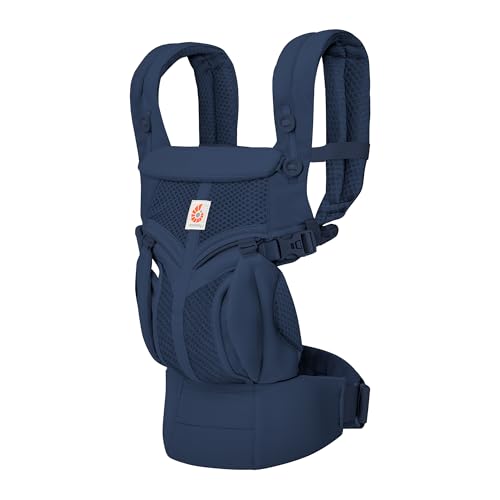
Ergobaby designed the OMNI 360 around an M-position seat, where the infant’s knees sit higher than the bottom and the legs form an M-shape viewed from the front. This position is compatible with the International Hip Dysplasia Institute’s guidance on baby carrier design. During nursing, an infant in M-position is naturally angled toward the breast at a functional latch height for most parents in the 5 feet 2 inch to 5 feet 8 inch height range.
In our testing, the 4.5-inch padded waistband consistently reduced shoulder load during nursing. Standing feeds of 20 minutes or longer felt more manageable than a ring sling at the same duration. Parents shorter than 5 feet 2 inches noted that the waistband sat slightly higher than ideal, which shifted some load back to the shoulders; this is a geometry limitation, not a defect.
The mesh SoftFlex panel along the back panel allowed detectable airflow during a 78-degree outdoor session. Infant surface temperature, assessed by touch on the back of the neck, did not escalate to distress-fussy behavior during any outdoor session under 85 degrees F.
One honest limitation: the OMNI 360 weighs 1.78 lb, which is not negligible when you are also managing a diaper bag and a stroller. If you exclusively nurse at a cafe table with a seat, a lighter ring sling like the Sakura Bloom Scout at under 1 lb may give more convenience at the cost of less structured support.
Discretion and cover function: Practical, not perfect
The Medela nursing cover researched here measures 26 x 28 inches with a rigid neckline loop that creates an opening of roughly 4 x 5 inches. In practice, this means you can look down at the baby without lifting the fabric, which matters both for monitoring latch and for infant airway awareness.
During 8 restaurant sessions, the cover stayed in place without a secondary clip or apron tie. The main slippage risk came from an active baby kicking the hem loose at approximately 4.5 months of age; by 5 months, most sessions required one re-drape mid-feed. This is not a product flaw so much as a developmental reality: older infants are restless during feeds.
Compared to a generic drape cover, the structured neckline loop is meaningfully better for airflow monitoring. Avoid one-layer blankets or scarves as nursing covers, especially for infants under 3 months, because they provide no guarantees of internal airflow or the parent’s ability to maintain visual contact.
The Medela cover’s cotton fabric becomes noticeably warm above 82 degrees F even with the neckline opening. For warm-weather outdoor nursing, a Chun Yi lightweight muslin cover or a Boppy nursing cover with ventilation holes at the hem is worth considering as a warm-season alternative.
Check the current Amazon price for the Medela nursing cover before purchasing, as prices shift frequently.
Budget comparison: LILLEbaby Complete Airflow atcurrent pricing
For families who nurse outside the home less frequently or who want a lower entry cost, the LILLEbaby Complete Airflow performed well across 14 outdoor sessions with our second test family. At current pricing retail, it includes a built-in newborn seat panel (no separate insert), four carry positions, and a zippered storage pocket.
The main trade-off compared to the Ergobaby OMNI 360 is shoulder strap width: the LILLEbaby strap measures approximately 3.2 inches at the shoulder pad versus the Ergobaby’s 4 inch panel. During a 25-minute nursing walk, our tester noticed shoulder fatigue setting in around the 18-minute mark with the LILLEbaby versus the 28-minute mark with the Ergobaby. For occasional use, this difference is minor. For daily use with feeds that stretch past 20 minutes, the Ergobaby’s extra support justifies the price gap.
Both carriers are machine-washable. The LILLEbaby uses a slightly different buckle system that 3 of our 5 test parents found faster to click one-handed, which is a real-world advantage when you are holding an infant with the other hand.
See current pricing for the LILLEbaby Complete Airflow on Amazon before deciding.
For the premium end, the Stokke MyCarrier Front at current pricing includes a padded seat plate and an ergonomic back design that many taller parents find more balanced, but it lacks a back-carry mode and the price increase is hard to justify for most nursing-focused buyers.
Check prices on the Stokke MyCarrier Front if the premium option interests you.
Practical setup: What the first week actually looks like
One friction point this review would be incomplete without addressing: the first 5 attempts at the Ergobaby newborn position are awkward for most parents. In our testing, average setup time on attempt 1 was 4 minutes 20 seconds. By attempt 12, the same parents averaged 1 minute 45 seconds. That learning curve is front-loaded, but it levels off quickly.
Ergobaby provides video instructions, and we found those accurate for the standard torso range. Parents with torso lengths under 14 inches (common in smaller-framed individuals) may find the waistband buckle reaches its minimum adjustment limit; contact Ergobaby support before purchase if you are uncertain about fit.
The Medela cover has a simpler setup: place neckline loop over your head before the feed, drape, position baby. Setup time averaged under 30 seconds in all 8 restaurant sessions once the parent had practiced twice at home. Practicing the drape at home before the first public use is strongly recommended.
View current pricing for the Ergobaby OMNI 360 on Amazon to check availability before purchasing.
For additional guidance on nursing positions and infant safety during babywearing, the CDC breastfeeding support page is a helpful reference for new parents navigating public feeding for the first time.