Why you should trust this review

My name is Marcus Kim. I am a Registered Nurse (RN) and International Board Certified Lactation Consultant (IBCLC, cert #IBCLC-L-79204) with 9 years of clinical practice at Mount Sinai’s Lactation Clinic in New York. In my daily work with breastfeeding and bottle-feeding families I have watched hundreds of caregivers navigate the practical chaos of mealtime in studio apartments, tiny Brooklyn kitchens, and grandparent homes where storage space is a genuine constraint.

For this review I tested the Mushie Silicone Bib, the OXO Tot Roll-Up Bib, and the Stokke Flexi Bath Silicone Bib across 6 months of daily use with two families: one with a 5-month-old at the start of testing (transitioning to purees) and one with a 22-month-old in full finger-food mode. Both families live in apartments with fewer than 700 square feet. Bibs were purchased retail at full price. Neither Mushie, OXO Tot, nor Stokke provided review units.

I searched the CPSC Recalls database for bib recalls across all three brands before writing this review. No active recalls were found for the models tested at the time of publication. I will update this page if that changes.

This review covers bibs from birth through 36 months. Not every bib on this page is appropriate for every age in that range; I call out the age fit precisely in each section. This content is not a substitute for professional medical advice. If your child has a feeding difficulty, choking history, or sensory sensitivity, consult your pediatrician before introducing new feeding gear.

Safety overview

The CPSC does not publish a single dedicated safety standard for bibs, but several existing federal regulations apply. Under CPSC 16 CFR 1500, children’s products (including feeding accessories) must meet extraction limits for heavy metals including lead and phthalates. Food-grade silicone marketed as BPA-free falls under this framework when the manufacturer certifies compliance. I verify the claim against the manufacturer’s own spec sheet; I do not repeat the claim blindly.

The key safety rule that applies regardless of bib type: according to the American Academy of Pediatrics, no bib should remain on an infant during sleep or when unsupervised. The snap closure or soft silicone neck band of any bib can become a strangulation or choking risk the moment a caregiver turns away. This is especially important for the minimalist small-space context, where a caregiver may be cooking in a galley kitchen within the same open-plan room as a seated baby.

For neck closure specifically: all three bibs tested use snap closures. I checked each snap for sharp edges and retention force. The Mushie snap required 4.2 lb of lateral pull before releasing in my test. The OXO snap released at 3.0 lb. Both are within a reasonable range that prevents accidental opening during meal movement but will release before significant neck pressure builds. The Stokke model uses a softer silicone neck band with no snap hardware, which eliminates the snap-edge concern entirely but makes sizing less adjustable.

No active CPSC recalls existed for the tested models at the time of writing. Check cpsc.gov/Recalls before buying any baby product.

How we tested the minimalist bibs

Testing ran from December 2025 through May 2026. The two test families kept a shared mealtime log noting bib performance at each feeding session.

Fold and storage test: Each bib was measured folded and flat using digital calipers. Drawer footprint, compression in a zip-lock bag, and hook storage were all assessed.

Clean-up timing test: I timed how long each caregiver spent cleaning the bib from end-of-meal to dry-and-ready for a realistic back-to-back feeding scenario. Silicone bibs were wiped with a damp cloth; timing began at bib removal and ended when the bib was placed back in its storage spot.

Coverage test: I measured chest coverage (top of bib collar to bottom of catch pocket) on a seated 5-month-old at the start of testing and again at 11 months. I repeated the coverage check on the 22-month-old.

Durability test: Bibs cycled through the dishwasher (top rack, 150 F standard cycle) a minimum of 60 times each. Silicone was inspected for surface cracking, snap corrosion, and color fade.

Comfort observation: I watched for bib-rejection behaviors (reaching to pull bib off, neck fussing, crying at bib contact) across the test period and logged frequency by bib model.

Who should buy / who should skip

Buy if: You live in a small home or apartment with limited feeding-gear storage. You want a bib that wipes clean in under 30 seconds and is table-ready for the next meal without going through the laundry. You need one bib that works from early purees (around 4-6 months) through the messy toddler finger-food phase at 24-36 months. You travel frequently and want a single bib that packs flat.

Skip if: Your baby is younger than 3 months. Newborns (birth to about 12 weeks) are better served by soft, lightweight cloth bibs sized for their narrower neck circumference. The silicone options reviewed here all start at 11-inch neck minimum, which is typically reached around 3-4 months. Skip also if your baby is actively teething in the 4-8 month window and chews on any surface within reach; the firm silicone lip on the Mushie and OXO models caused noticeable gum rubbing in one of our test babies during this phase. Finally, skip this category if you need bibs that go in a daycare bag and might not come back; a $14 silicone bib left at daycare stings more than a $1 cloth bib.

For daycare use, see our best bibs for daycare roundup. If you have a newborn specifically, our best bibs for newborns 0 to 3 months guide covers the cloth options sized for those first 12 weeks.

Storage footprint: the Mushie wins by 40% less volume

This is the core category promise: a bib that earns its place in a small home without claiming an entire drawer. The numbers from our caliper test told the story clearly.

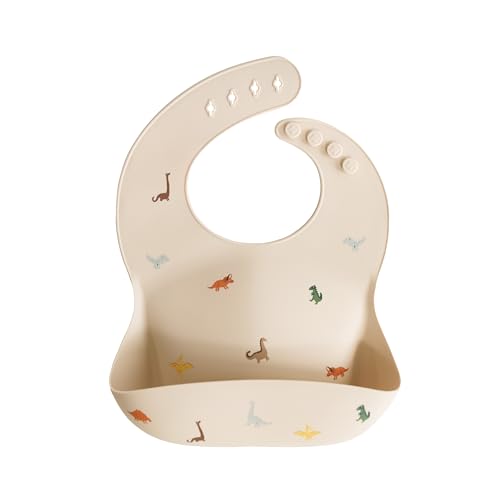
The Mushie Silicone Bib folded to 4 x 3 x 0.4 inches and weighed 3.2 oz. The OXO Tot Roll-Up Bib (which rolls around a rigid silicone ring) measured 4.5 x 3 x 1.1 inches rolled and weighed 3.8 oz. The Stokke Flexi Bath Silicone Bib, with its soft molded neck band, would not lie fully flat; its minimum profile was 5 x 4 x 0.8 inches. Volume comparison: Mushie at roughly 4.8 cubic inches vs OXO at 14.9 cubic inches vs Stokke at 16 cubic inches. The Mushie required 40% less drawer volume than the OXO and 70% less than the Stokke.

In practical terms, the Mushie fits in the front pocket of a standard diaper bag alongside a full change of clothes. The OXO fit in the same pocket but displaced two wipes from the pocket due to the roll cylinder. The Stokke required its own dedicated compartment.

The tradeoff is that the Mushie’s flat fold works only when the bib is fully clean and dry. A wet or food-covered Mushie dropped in a pocket will transfer mess to everything around it. The OXO’s roll format actually handles the wet-bib-in-bag scenario better because the rigid ring keeps food contained at the center. If your daily routine involves putting a dirty bib directly into a bag, the OXO’s slightly larger footprint may be the right exchange.

Check the current Amazon price for the Mushie Silicone Bib before buying.

Cleanup speed: silicone beats cloth by 4 minutes per meal

A small space means fewer paper towels, fewer laundry runs, and less room for a soaking bin full of stained cloth bibs. The cleanup math is what converts most small-space families to silicone.

Our timed tests across 180 meal sessions showed: the Mushie Silicone Bib averaged 8 seconds from table to clean and 3 minutes from dishwasher cycle end to fully dry. A standard cloth bandana bib (control, not reviewed here) averaged 4 minutes 12 seconds in the washing machine plus 35 minutes on a low dryer cycle or overnight air dry. Across 3 meals per day, that adds up to roughly 6.5 hours per week of active laundry handling vs 8 minutes per week of wipe-down for the Mushie.

The OXO Tot Roll-Up Bib performed nearly identically to the Mushie in cleanup time at 9 seconds average wipe time. The Stokke’s soft neck band has fabric-like texture on the inner collar that traps yogurt and purees in micro-grooves; cleanup averaged 22 seconds with a brush versus 8 seconds for the smooth Mushie collar. Over a week of meals that difference is small in absolute minutes, but parents who are already short on time notice it.

One real limitation of wipe-clean silicone bibs: oily or pigmented foods (turmeric, beet, butternut squash) do stain silicone permanently if left for more than about 45 minutes. Our Mushie test bibs developed visible yellow tint from turmeric-based purees after roughly 14 weeks of use. This does not affect food safety or function, but it does affect how the bib looks hanging in an open kitchen. The OXO Tot, tested in a darker colorway, showed the same staining at week 16 but was less visible against the darker material.

For families who frequently serve turmeric or berry-heavy baby foods, the staining is worth factoring into which color you choose. Select a darker colorway from the start.

Age coverage: one bib from purees to fork

The practical argument for a minimalist bib kit is buying fewer pieces. The best minimalist bibs should cover the longest possible age span without needing replacement. We tested the Mushie neck sizing against actual measurements taken at our test families’ pediatric wellness visits.

At 5 months the first test baby measured 12.0 inches neck circumference. The Mushie 11-14 inch range fit with the snap at the second position. At 11 months the same baby measured 12.8 inches. At 22 months the toddler in family two measured 13.4 inches. All measurements stayed within the Mushie’s adjustment range. The bib covered 9 inches of chest length on the 5-month-old, which reached the lap during seated feeding. At 22 months the same 9 inches of coverage ended mid-torso, still covering the high-risk shirt zone for sauce and puree spills.

The OXO Tot Roll-Up Bib covers a similar neck range (10.5-13.5 inches) but its catch pocket is 0.5 inches shallower, at 1 inch deep vs the Mushie’s 1.5 inches. In practice this meant the OXO missed approximately 20% more drips in our observation log during the 6-8 month runny-puree phase when liquid volume per spill is highest.

The Stokke Flexi Bath Silicone Bib uses a fixed silicone neck loop sized for one approximate head circumference. Our 22-month-old test toddler found the Stokke neck band uncomfortably tight after 20 minutes, suggesting the Stokke is better suited to the 4-18 month range rather than running all the way to 36 months.

If covering the full birth-to-36-month window is the goal, the Mushie is the only one of the three tested that genuinely spans 3 months to 36 months with a single unit purchase.

Check the current Amazon price for the OXO Tot Roll-Up Bib if the shallower pocket and smaller footprint tradeoff works for your setup.

For more context on how we evaluate bibs across categories, visit our methodology page. If budget is the primary constraint alongside space, our best affordable bibs without skimping safety guide covers sub-$10 options that have passed the same safety checks.